Story Drama For Knots On A Counting Rope By Bill Martin & John Archambault. Illustrated By Ted Rand
Intro
Teacher: Gather students on the carpet in the classroom. “It’s important that we remember that this book was written a long time ago, in 1966. Back then, people didn’t always understand or respect that Indigenous stories belong to families and communities. Today, we know it’s important to listen carefully and honor who the story comes from.”
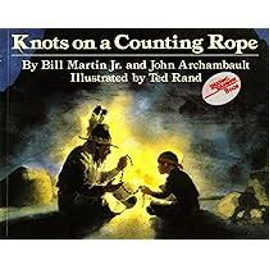
Teacher: Introduce the book by doing a cover analysis. “What do you think this book could be about based on the cover and back illustrations?” “Let’s take a look at the illustrations and the title. Talk with your partner about what you think the book might be about. Share your ideas and listen to each other. There are no wrong answers!”
Students: Pair and share, in groups of 2-3 students (2 mins)
Activity – Step Up to the Line (3 mins)
Materials: No materials needed, story book only.
Focus: This activity helps students connect the story to their own lives. Stepping forward shows what relates to them, and the discussion uses these ideas to think about what the book is really about.
Teacher: “Now we’re going to play a game called Step Up to the Line! First, make two lines facing each other. I’ve put a line of tape in the middle. This is the ‘step-up line.’ I will read a statement, and if it’s true for you, step onto the line for just a moment. Then step back into your line. We’ll do this for several statements, and not everyone will step up for everyone and that’s ok! Just be honest and have fun!”
- Step up if someone in your family tells you special stories.
- Step up if you can remember a story someone told you about when you were little.
- Step up if nature helps you feel calm.
- Step up if you have been somewhere that felt peaceful.
- Step up if you kept trying even when something was hard.
- Step up if you enjoy telling stories to others.
- Step up if someone encouraged you when you felt unsure.
- Step up if you have a special memory with a grandparent.
- Step up if a story has ever made you feel better when you were scared.
- Step up if you enjoy riding horses or learning about animals.
Teacher: After activity is finished, gather students back at the carpet. Prompt the students to discuss what they think the book is about through pair and share. “Okay, now that we are finished playing Step Up to the Line, I’d like you to find a partner and discuss what you think the book may be about based on some of the statements in the game.”
Students: Pair and share, in groups of 2-3 students (2 mins)
Story begins
Teacher: Read pages 1-5.
Activity – Frozen Tableau (7 mins)
Materials: No materials needed, story book only.
Focus: This activity lets students act out an important part of the story, showing feelings, relationships and themes like courage and love, while working together and having fun.
Teacher: “Now that we have read a bit of the story, I want you to get into groups of 4 and depict the scene of the sleeping boy in his grandfather’s arms petting the two horses by creating a Frozen Tableau. Frozen tableaus are portraying a character’s emotions and facial expressions without any movement and no talking. Your bodies and facial expressions should retell the scene in the story. One person will be the baby. How can your body show that you are a small, sleeping baby? Maybe curl up, close your eyes and stay very still. Two people will be the horses. Think about how horses stand. Can you make your body tall and strong? Maybe bend forward slightly, hold your hands like a horse’s head, or show your legs ready to gallop. The last person will be the grandfather. How could you show that he is protecting the baby? Try holding the baby tight in your arm and raising your other arm toward the horses. Think about the feelings in the scene. Are the horses calm and curious? Is the grandfather surprised or peaceful?”
Students: Students will break into groups of 4 and will have 3 minutes to think of their frozen tableau and which characters they will be portraying. After, the teacher will prompt each group to show their frozen tableau to the rest of the class.
Teacher: “Okay everyone, time is up. We will now go around to each group, and each group will have the opportunity to show the class their tableau. We will all have a chance to observe each tableau and see which character is being portrayed.”
Story Continues – Teacher prompts students to come back to carpet
Teacher: Read pages 6-9 pages (including illustration pages)
Activity – Art Poster (Individual) (20 mins)
Materials:
- Regular size paper for each student
- Pencils
- Coloured pencil crayons or markers
Focus: This activity helps students connect the story to their own happy memories, showing how memories can bring comfort and strength, just like for the boy in the story.
Teacher: Introduce key concepts learned so far. “I want you to think about what blue means to you. How does blue make you feel? Once you have an idea, I’d like you to take time to create a visual of a memory or something that makes you feel happy.” Show your own example. Prompt students to create individual posters with visuals that answer these questions.
Students: Work independently on posters.
Story Continues – Teacher prompts students to come back to carpet
Teacher: Read the remaining pages of the book.
Activity – Knots of Courage – Personal Reflection (20 mins)
Materials:
- Yarn or string (18–24 inches per student)
- Beads
- Masking Tape (for labeling knots)
- Markers
- Pencils
- Paper (for brainstorm)
- Scissors
Focus: This activity helps students reflect on their brave moments and personal growth, while building confidence and sharing with classmates.
Teacher: Discuss the importance of constant self-check-ins and reflection. Introduce the “Knots of Courage” activity. Students will receive all the materials they need to create their own personal “courage rope” with knots representing important memories, accomplishments, or moments of courage.
Teacher: “Today, you will create your own counting rope. Each knot will stand for an important memory, moment of bravery, or special event in your life. I’d like you to brainstorm 3-5 important memories, accomplishments, or moments of courage that you’ve endured. You can use words, pictures or short phrases.” Show your own example.
Students: Brainstorm (5 mins)
Students: After brainstorming 3-5 ideas, it’s time for students to create their individual knot rope. Students will tie a colourful bead at the knot as well as a piece of tape with their special moment on it (short phrase, word or visual). (15 mins)
Teacher: “Now that you’ve made your memory ropes, find a new partner to share with. Remember, these are your own memories, so let’s listen carefully and make sure our friends feel heard and understood.” (Groups of 2-3 / 2mins)
Conclusion Activity – Guided Imagery (Final Class Reflection) (5 mins)
Materials: No materials needed, story book only.
Focus: This activity helps students imagine how the boy feels, building empathy and understanding themes like love, courage, and reassurance.
Teacher: Direct students to come back to the carpet. Prompt students to shut their eyes and put themselves in the boys’ shoes (students in role – being blind). “Okay, everyone, close your eyes for a moment. I want you to imagine that you are the boy in the story. Try to think about what it would feel like if you couldn’t see. What would you notice with your other senses? How would the world feel different?”
Students: Close their eyes and envision what life would look like for the boy in the story.
Teacher: “Think about how the boy might feel after hearing his grandfather’s story. Now, think about how he feels when his grandfather says his love will always be with him. Finally, think about how the boy and his grandfather are connected to the story.”
This activity is all done individually.
Students: Thinking quietly about how these questions relate to the boy, themselves, and their own families.
End Scene